

Trends: When to set, follow, be against, or completely outside them?
Combining trends with your own ideas: a contemporary interior design scene with a poster I designed
It seems like everyone (and their dog) these days claims that they are the “outside-the-box” thinker, or “going against the trends”. But is it so? Why and when does your business actually benefit from this type of positioning?
If we divide your positioning toward the trends, it could look like:
1. Setting the trends
2. Following/being in trend(s)
3. Against the trend
4. Outside trends altogether
Let’s break down where your business is, and which option would benefit you the most.
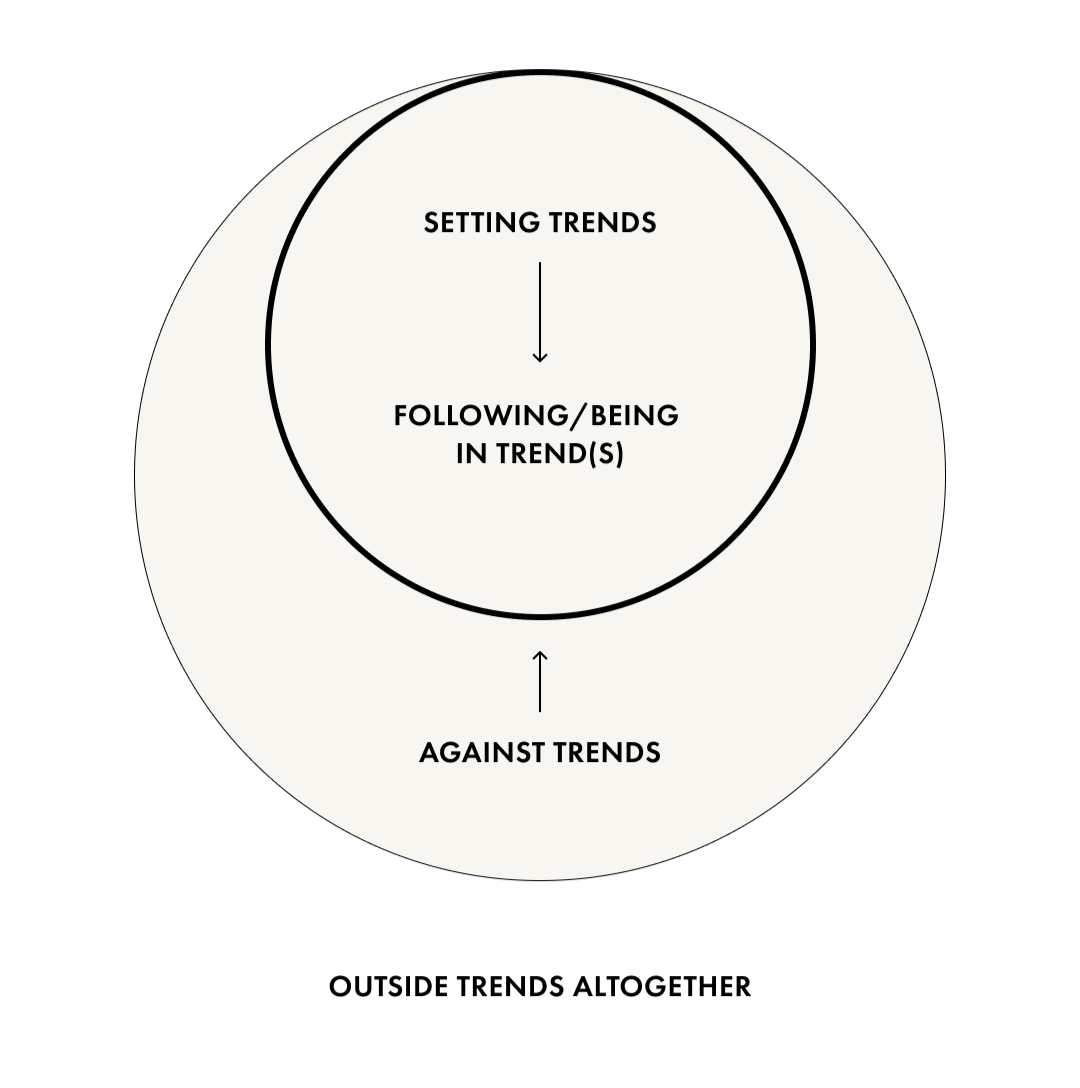
Trends positioning: Where does your business belong?
Setting the trends
Pros: You establish a certain position, where everyone is subjected to two choices: following or being against
Cons: Costly while you build your path towards that establishment, and you will likely be misunderstood on the way
Starting Archetype: can be any, best practice is The Rebel
Main Archetype: The Ruler
No matter how much we hate to admit it, there is a need for role models. For appearance of structure. For the ideal.
We unconsciously strive for certain things and, on that deep level, raise them on a pedestal.
Whether these things are grouped in an image, an idea, a system of values, or somehow projected onto a person, the pedestal is there and waits for someone/something to take over and finally start ruling.
So, who should do this? Who is best equipped to take on such a challenge?
Usually:
category leaders,
companies with cultural influence,
brands with strong conviction,
businesses with enough capital/risk tolerance.
Setting trends is expensive because:
the market may not understand you yet,
education costs are high,
people resist unfamiliarity.
Example themes:
early Apple minimalism,
Patagonia’s anti-consumer stance,
quiet luxury before it became mainstream.
What makes the Apple case so interesting?
Because, in short, it went from The Rebel to The Ruler.
And this route can be very challenging, but it pays off hugely, because you can get an almost cult-like following.
The same tactic has been and continues to be quite useful in politics as well.
Following/being in trend(s)
Pros: Safe bet for all sorts of businesses, you signal trust to your customers from the start
Cons: the short life span of current trends and losing recognition
Starting Archetype: any can do
Main Archetype: industry-fitting
Believe it or not, but following/being in trend, is neither good or bad.
It really depends on your goals.
If you wish your business to look “up to date”, then following a certain trend is a must.
If you need to attract the real decision-makers, aka shareholders, then following a certain trend is, I’m afraid, again a must.
You get the image here.
Also, there are many cases where a business would claim they are “against the trend” because, well, that IS THE TREND in a specific industry. For example, many of these examples can be found in the design industry, the IT sector, and all things entrepreneurial.
So it becomes trendy to be “against trends”. The irony and dissonance are commonly, on purpose, missed here. But more about it later.
To make it simple, sometimes following/being in trend just means:
speaking the current visual language of a specific industry,
reducing friction,
showing relevance,
meeting certain expectations.
Example:
If every fintech app became cleaner and simpler UX-wise, refusing to follow that trend might make your product harder to trust.
At the end, there’s a difference between:
adapting to evolving standards, and
chasing certain aesthetics without strategy.
Against the trends
Pros: Instant differentiation, challenging the status quo of whatever industry, memorable
Cons: Can repel true customer base and shareholders, and sometimes appear not professional
Starting Archetype: against whatever the industry standard is
Main Archetype: The Rebel needs to be present at least in some dose
Finally, we come to infamous “against the trends” part.
This is where many brands become performative.
What can start as a true urge to challenge the status quo can also become just another brand with only the appearance of doing so. There is almost a certain kind of luxury, a moral prestige in being David against Goliath. We love to root for the underdog, and we all somehow identify with it.
This “anti-trend” itself often becomes a trend. Ironic, isn’t it? And sometimes it becomes a standard messaging within certain industries, such as design, IT, AI, or similar.
Examples:
“raw branding,”
ugly design aesthetics,
anti-corporate tone,
brutalist web design,
“authentic imperfection.”
Once enough brands do it, rebellion becomes just another visual conformity again. Just another aesthetic.
Somehow, it reminds me of what happened in the late ‘70s with the punk movement. What truly started as an expression of youth became just another “look”. How can you embody your raw, punk values if you’re wearing Dr Martens shoes, which are usually more expensive than your average, “mainstream” looking ones?
So, when should you use this positioning?
This is where clarity about your values is extremely important.
Once you establish it, then you can evaluate where you truly belong and how it reflects within your industry.
If your values are indeed quite in opposition, then this “anti-trend” approach will feel natural, and it’s not even going to have to “look the look” because this is already embodied in your business. The basis is truly against the status quo, so ironically, your business can even look like the most common Everyman. There are all sorts of variations.
How I divide it is simply the following:
HOW → then it is aesthetics, which is not bad, but can turn to pure or worse, hollow performance
WHY and/or WHAT → then it is a true core, the reason behind everything, and can turn into a life call or lifestyle
Outside trends altogether
Pros: timeless, trustworthy, steady, not following or against anything, self-possesed
Cons: the recognition takes more time, it could benefit the brand to look a certain way to appear professional
Starting Archetype: can be any, often Rebel
Main Archetype: can be any, if rooted in a strategic approach
Ah, at last we come to the most misunderstood position:
Being outside trends altogether.
How to reach this?
Well, by being honest about your standing.
This is the most important thing you can do as a business-owner.
What use of a rebrand into something that is trendy, but appears edgy (because again, that is trending at the moment), if it doesn’t relate to your customers? To whom are you messaging? Who are you trying to attract? If you’re trying to attract at all… Maybe you have been committed to delighting your peers, your competition, and what seems to be virtuous at the moment?
Let’s take a moment to acknowledge that all positionings need to deliver the business’s meaning in the most clear way.
And sorry to inform you, that means that sometimes you do “think inside the box”, and there is nothing bad about it, if it serves your business’s goals. Not everyone can be, or should be, the same.
And while we are at it, maybe you even provide the most reliable box, or make the most prestigious, luxurious box.
You get my point here.
There is no truly prestigious position. Everything needs to serve a purpose in your business strategy.
Being outside the trends means you do acknowledge them, but only take what is meaningful for your business’s needs, as well as from the position of opposing them. You combine these different angles and truly search for your own unique brand expression.
This is done with strategic sharpness and can result in the most sincere, almost timeless expression of your brand.
